Book Spotlight: Kant’s Critique of Aesthetic Judgment in the 20th Century

This wonderful volume edited by Stefano Marino and Pietro Terzi offers the reader a comprehensive account of the influence and reception of Kant’s Critique of the Power of Judgment in the 20th century. The book consists in eighteen chapters and has an international list of contributors.
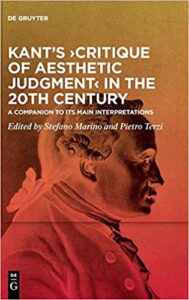
Chapters are devoted to Kant’s influence on the phenomenological and hermeneutical traditions. For example, Günter Figal’s chapter, “Blank Spaces and Blank Spots,” investigates Heidegger’s apparent ignoring of Kant’s third critique. That is, in both the “Origin of the Work of Art” and his 1936–37 lecture course on the same topic, where he critiques Erlebnis-Ästhetik “Heidegger presents the philosophical project of aesthetics without mentioning the book that in general is most closely associated with it: Kant’s Critique of the Power of Judgment” (61). Dennis J. Schmidt’s chapter, “The Place of Kant’s Critique of the Power of Judgment in Gadamer’s Hermeneutics,” charts Gadamer’s complex engagement with Kant in part 1 of Truth and Method. Although Gadamer’s hermeneutic-aesthetic project draws from Aristotle and Heidegger, Schmidt argues that the “Critique of the Power of Judgment is the key text in the formulation of hermeneutic theory for Gadamer” (76).

Chapters are likewise devoted to the Frankfurt School’s reading of Kant. For example, Tom Huhn’s chapter, “Disinterest and an Overabundance of Subjectivity,” shows how, despite Adorno’s embrace of Hegel’s critique of Kantian aesthetics and his (Adorno’s) own critique of the same, the influence of Kantian aesthetics persisted in Adorno’s thought.

The volume also includes various readings of Kant by key thinkers in the French tradition. For example, Anne Sauvagnargues’s chapter, “The Discordant Accord of the Faculties: Deleuzian Readings of Kant,” argues that although Deleuze often criticizes Kant, he regularly returns to Kant’s third critique and utilizes Kantian insights (often creatively reinterpreted) to develop his own thought. Sauvagnargues charts Kant’s influence on several of Deleuze’s texts including Difference and Repetition (1968) and especially in his late philosophy where “the importance of Kant and his analysis of the sublime stand out as major references in his philosophy of cinema, the image and time (The Movement-Image [1983] and The Time-Image [1985]) (195).

Also noteworthy is the detailed Introduction by Stefano Marino and Pietro Terzi, which does an amazing job—within a limited textual space—of tracing the history and geography of Kant’s reception. The volume comes highly recommended and will be of interest to Kant scholars as well as those interested in aesthetics, the philosophy of art, and the influence of Kant on contemporary German and French philosophical traditions.
NASPH/SPEP 2021 Satellite Session

For those planning to attend SPEP 2021, we invite you to attend the North American Society of Philosophical Hermeneutics’ Satellite Session which will take place on Sunday, Sept. 26, 11 am – 2 pm EST. (You have to register with SPEP to gain an access key. Please visit SPEP.com to register. ) Below is the program for the NASPH session. We hope to see you there!

Panel 1: “Hermeneutical Aesthetics and Ethics”

  1. Cynthia R. Nielsen (University of Dallas), “Gadamer and Street Art”
  2. Catherine Homan (Mount Mary College) “Gadamer and the Possibility of Poetic Education”
  3. Alexander Crist (Texas A&M) “Poetic Dwelling, Ethos, and Trust in Philosophical Hermeneutics: Gadamer on ‘Vertrauen‘ and ‘Rückkehr‘ in the Poetry of Hilde Domin”

Panel 2: “New Directions in Hermeneutics”

  1. Ken Archer (Catholic University of America), “Hermeneutics of Technology and Agency”
  2. Bruce Ellis Benson (U. Vienna), “Queer Hermeneutix: On Being the Stranger”)

Hot off the Press: The Gadamerian Mind & A Discount Code

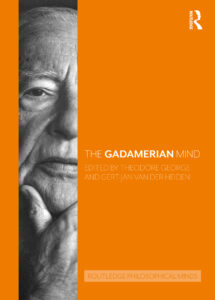
The Gadamerian Mind, edited by Theodore George and Gert-Jan van der Heiden has now been published!  A brief description of the volume from Routledge’s website is listed below.  Our readers can receive a 20% discount by entering this code: FLY21.

Book Description

Hans-Georg Gadamer (1900-2002) is one of the most important philosophers of the post-1945 era. His name has become all but synonymous with the philosophical study of hermeneutics, the field concerned with theories of understanding and interpretation and laid out in his landmark book, Truth and Method. Influential not only within continental philosophy, Gadamer’s thought has also made significant contributors to related fields such as religion, literary theory and education.

The Gadamerian Mind is a major survey of the fundamental aspects of Gadamer’s thought, with contributions from leading scholars of Gadamer and hermeneutics from around the world. Thirty-eight chapters are divided into six clear parts:

Overviews

Key Concepts
Historical Influences
Contemporary Encounters
Beyond Philosophy
Legacies and Questions.

Although Gadamer’s work addresses a remarkable range of topics, careful consideration is given throughout the volume to consistent concerns that orient his thought. Important in this respect is his relation to philosophers in the Western tradition, from Plato to Heidegger.

An indispensable resource for anyone studying and researching Gadamer, hermeneutics and the history of twentieth-century philosophy, The Gadamerian Mind will also be of interest to those in related disciplines such as religion, literature, political theory and education.

New Publication Coming Soon: The Gadamerian Mind (Routledge)

Our readers will be interested in a new publication, The Gadamerian Mind, edited by Theodore George and Gert-Jan van der Heiden. The volume will be available for pre-order on August 25, 2021. A brief description of the volume from Routledge’s website is listed below. A preview of the proofs for Cynthia R. Nielsen’s chapter, “Gadamer on Play and the Play of Art,” can be found here.

Book Description

Hans-Georg Gadamer (1900-2002) is one of the most important philosophers of the post-1945 era. His name has become all but synonymous with the philosophical study of hermeneutics, the field concerned with theories of understanding and interpretation and laid out in his landmark book, Truth and Method. Influential not only within continental philosophy, Gadamer’s thought has also made significant contributors to related fields such as religion, literary theory and education.

The Gadamerian Mind is a major survey of the fundamental aspects of Gadamer’s thought, with contributions from leading scholars of Gadamer and hermeneutics from around the world. Thirty-eight chapters are divided into six clear parts:

Overviews

Key Concepts
Historical Influences
Contemporary Encounters
Beyond Philosophy
Legacies and Questions.

Although Gadamer’s work addresses a remarkable range of topics, careful consideration is given throughout the volume to consistent concerns that orient his thought. Important in this respect is his relation to philosophers in the Western tradition, from Plato to Heidegger.

An indispensable resource for anyone studying and researching Gadamer, hermeneutics and the history of twentieth-century philosophy, The Gadamerian Mind will also be of interest to those in related disciplines such as religion, literature, political theory and education.

Hermeneutics in Real Life: A New Project by Todd Mei

Our readers will be interested in Todd Mei’s new project, Hermeneutics in Real Life (HINRL). He describes his project as being “open to anyone interested in the application of hermeneutics to real life. The project includes online resources and a monthly, hour long, online discussion on topics applying hermeneutics to various areas of real life. While hosted by Ricoeur scholars, the invitation to participate is extended to the entire hermeneutics community, including those new to the field. ”

HINRL has an upcoming event featuring Prof. Richard Kearney. You can register for the event here.

Dialogical Breakdown and Covid-19: Solidarity in a Shared World

For those interested, here’s a recent article that Drs. Cynthia R. Nielsen David Liakos co-authored entitled: “Dialogical Breakdown and Covid-19: Solidarity and Disagreement in a Shared World.” (You can download the article for free from the Journal of Applied Hermeneutics.) See abstract below.

Abstract: This article considers the limitations, but also the insights, of Gadamerian hermeneutics for understanding and responding to the crisis precipitated by the Covid-19 pandemic. Our point of departure is the experience of deep disagreements amid the pandemic, and our primary example is ongoing debates in the United States about wearing masks. We argue that, during this dire situation, interpersonal mutual understanding is insufficient for resolving such bitter disputes. Rather, following Gadamer’s account of our dialogical experience with an artwork, we suggest that our encounter with the virus gives rise to new ways of seeing and experiencing ourselves and the world. Further, we draw on Gadamer’s account of the fusion of horizons to show how even competing perspectives on wearing masks arise within a shared space of meaning created by the virus. These insights provide hope for an improved model of political dialogue in the world of Covid-19.


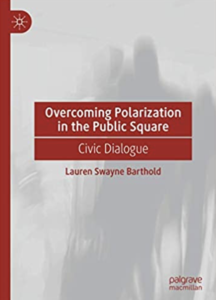
Mini-Review of Overcoming Polarization in the Public Square: Civic Dialogue by Lauren Swayne Barthold

Lauren Swayne Barthold’s new book, Overcoming Polarization in the Public Square: Civic Dialogue.

The book is comprised of six chapters and makes a case for how dialogue can help to break through particularly polarized sociopolitical spaces. According to Barthold, when the public square has become throughly polarized and people seem to ignore or have no interest in rational argumentation or appeals to empirical facts, the focus should turn first to  building trust so that openness and mutual understanding can occur. On Barthold’s view, civic dialogue must be structured in such a way that it creates a space for genuine listening and reflecting on one’s own position and the other’s. The hope is that while acknowledging the real differences that exist among individuals and groups, such structured dialogue will allow what we share in common as human beings to come into focus.

Barthold draws from a variety of dialogue partners and texts including Plato’s Socrates from the Republic, Martin Buber, John Dewey,  Hans-Georg Gadamer, Hannah Arendt, Miranda Fricker, and contemporary research on cognitive bias. While engaging philosophical sources and insights, Barthold also turns to the work of dialogic practitioners. E.g., in chapter 4, she discusses an approach to dialogue called, “Reflexive Structured Dialogue,” which “places first person experience and narrative” at the center of dialogic practice (Overcoming Polarization, p. 19). Against the conclusions of certain practitioners who claim that mutual understanding is a form of empathy, Barthold argues that “the goal of dialogic understanding should not be conceived as empathy–either emotional or cognitive.” Rather, in accord with insights from Buber and Gadamer, Barthold contends that “mutual understanding is best defined as acknowledging the other’s claim to existence as a Thou. To take up the truth claim of the other is to engage in a dialogic relationship that affirms the other’s status as a Thou.” (ibid., p. 21).

Given the current dialogical breakdown, polarization, dismissal of science, and lack of trust among differing groups in the United States, Barthold’s book is a welcome contribution to both the public sphere and the classroom.

If you want to learn more about Lauren’s book, you may listen to her discuss the book in an interview on the podcast “Ethics in Action.”

NASPH 2020 Virtual Conference Information

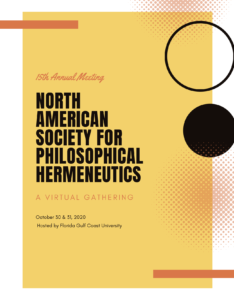
Due to the ongoing COVID-19 pandemic,  the NASPH 2020 annual meeting will take place via Zoom on the afternoon of Friday October 30 and from mid-morning to mid-afternoon on Saturday October 31.

Though the format will be unusual, we have an amazing lineup of speakers including Dr. Ted George, Dr. Lauren Barthold, and Dr. John Arthos and a panel on “Ricoeur and the Just University,” featuring Dr. Dan Boscaljon, Dr. Jeff Keuss, and Dr. Glenn Whitehouse. We look forward to lively discussions and hope that you will join us!

For more information about the program, speakers, and papers, see our listing in PhilEvents.

Lastly, more information will be posted soon on the NASPH website, including how to obtain the Zoom link to enter the conference, etc.

Please share widely!

The Responsibility to Understand Hermeneutical Contours of Ethical Life by Ted George

Our readers will be delighted to know that Ted George’s new book, The Responsibility to Understand: Contours of Ethical Life (Edinburgh University Press 2020) has now been published. Below is a brief description of the book from EUP’s website.

Responsibility to UnderstandWhat is the significance of hermeneutics at the intersections of ethics, politics and the arts and humanities?

  • Discusses how hermeneutics offers ways to develop an ethics
  • Makes the case for the relevance of contemporary hermeneutics for current scholarly discussions of responsibility within continental European philosophy
  • Contributes a new, ethically inflected approach to current debate within post-Gadamerian hermeneutics
  • Extends his analysis to the practice of living and covers animals, art, literature and translation

Few topics have received broader attention within contemporary philosophy than that of responsibility. Theodore George makes a novel case for a distinctive sense of responsibility at stake in the hermeneutical experiences of understanding and interpretation.

He argues for the significance of this hermeneutical responsibility in the context of our relations with things, animals and others, as well as political solidarity and the formation of solidarities through the arts, literature and translation

Call for Papers: “Psychoanalysis and Hermeneutics” for a special issue of Critical Hermeneutics

For those interested, the  journal Critical Hermeneutics is devoting a special issue to the theme “Pscyhoanalysis and Hermeneutics.” See details below or view the original CFP on PhilEvents.

CRITICAL HERMENEUTICS

http://ojs.unica.it/index.php/ecch

Call for Papers Vol. 4, n.2, December 2020

Psychoanalysis and Hermeneutics

Guest Editors: Ignacio Iglesias Colillas (Psychoanalyst / PhD_University of Buenos Aires), Giuseppe Martini (Italian Psychoanalytic Society)

Deadline (full paper): 1 December 2020

css.php