
Hans-Georg Gadamer. Cuestiones abiertas / Open Questions, edited by Facundo Bey.
This volume celebrates Gadamer’s enduring legacy on the 125th anniversary 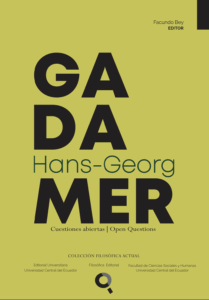 of his birth by embracing the transformative power of questioning as the heart of both philosophical inquiry and human existence. In our age of fragmentation and polarisation, Gadamer’s hermeneutics offers a vital path forward—not through definitive answers, but through questions that keep understanding perpetually open. This bilingual collection of fourteen original contributions from world-renowned scholars—twelve in English and two in Spanish—aims to demonstrate how the courage to question disrupts calcified opinions and creates spaces for genuine dialogue. The volume is honoured to include a prologue by Professor Jean Grondin.
The book explores the enduring relevance of Hans-Georg Gadamer’s philosophical hermeneutics in our contemporary world. Gadamer’s philosophy of understanding offers possibilities that transcend disciplines and traditions, making his thought particularly valuable for addressing current challenges. Published by Filosófica, Fundación de Estudios Filosóficos, Políticos y Culturales, in collaboration with the Editorial Universitaria of the Central University of Ecuador, the book is available for free download, ensuring the widest possible accessibility.
The work is structured into five thematic parts: 1) Language, Tradition, and Questioning in Philosophical Hermeneutics; 2) Reason, Meaning, and Science; 3) Ethics, Politics, Practical Philosophy; 4) Philosophy and Religion; and 5) Gadamer and the Classics.
Table of Contents
Prólogo / Prologue (Jean Grondin)
Introducción. Cuestiones abiertas / Introduction. Open Questions (Facundo Bey)
FIRST PART: LANGUAGE, TRADITION, AND QUESTIONING IN PHILOSOPHICAL HERMENEUTICS
Chapter I: Is Tradition Truly a Thou? (John Arthos)
Chapter II: The Hermeneutic Priority of Which Kind of Question? A Speech Act Proposal for Interlocutionary Acts (Nathan Eric Dickman)
Chapter III: Hermeneutic Ambiguities: Language, Historicality, and Truth (Dieter Teichert)
Chapter IV: Gadamer’s Metaphysics of Play (Eddo Evink)
SECOND PART: REASON, MEANING, AND SCIENCE
Chapter V: Gadamer and Nietzsche on the Question of Science: ‘The Victory of Scientific Method Over Science’ (Babette Babich)
Chapter VI: Reason, History, and the Universality of the Hermeneutical Problem (Roger W. H. Savage)
Chapter VII: Meaning and Evolution (Mirela Oliva)
THIRD PART: ETHICS, POLITICS, PRACTICAL PHILOSOPHY
Chapter VIII: Sobre la Virtud de la Responsabilidad: Una Trama Epistémica a Partir de la Hermenéutica (Luiz Rohden)
Chapter IX: Gadamer’s Conception of Phronesis and the Crisis of Democracy (Darren Walhof)
FOURTH PART: PHILOSOPHY AND RELIGION
Chapter X: On the Relation of Religion and Philosophy: Gadamer and Strauss (Walter Lammi)
Chapter XI: Gadamer’s “Classical” Philosophy of Religion (Abdullah Başaran)
FIFTH PART: GADAMER AND THE CLASSICS
Chapter XII: The Problem of Experience and the Ambivalent Status of Aristotle in Wahrheit und Methode (Antoine Pageau-St-Hilaire)
Chapter XIII: Gadamer en Diálogo con los Pensadores Iniciales (Einar Iván Monroy Gutiérrez)
Chapter XIV: A Phenomenology of the pólis? Ethics, Dialectic and Hermeneutics in Gadamer’s Early Interpretation of Plato (Facundo Bey)
